Overview of the Courses

Keelboats & Cruising Program

"Sail Canada" is designated by the Government of Canada as a National Sport Organization representing the sport of Sailing. The Association represents both recreational sailors and high performance athletes at national and international level. Programs include Keelboats & Cruising, Navigation, Dinghy sailing, Windsurf as well as Able Sail (Para) and Powerboating.
Keelboat program has four major on water training steps: Basic, Intermediate, Advanced and Offshore. Navigation is also split into four levels, thought in classroom and applied on water.
"Basic Cruisign Standard" is the first skipper level certificate. The objective is the safe boat operation under sail and under power. Proper procedures for essential manoeuvres - upwind and downwind sailing, tacking, gybing, docking, casting off, anchoring, etc. Adequate skill levels for daycruising in familiar waters and in moderate conditions by day.
"Intermediate Cruising Standard" is the next step, all of the skills from the "Basic" brought to a higher level with addition of cruising elements. Operating the boat should now be at near reflex level so that skipper can devote his/her mind to the safety of the entire crew and overall boat life. The standard is adequate for extended cruises in moderate conditions in coastal waters and for bareboat chartering.
"Advanced Cruising Standard" is coastal cruising expert level. In depth knowledge of boat systems, use of spinnaker and genaker, advanced navigation techniques includng use of radar, COB search and recovery in reduced visibility... Up to 100 miles of shore, by day or night, in any weather.
"Offshore Cruising Standard", sailing without the sight of land. World sailing routes, global weather patterns, self sufficiency,... More than 100 miles from the nearest land, minimum 500 miles continuous passage with celestial navigation.
At any level, students may achieve cruising (skipper) standard taking the command over the vessel, or "crew" standard.
Navigation standards follow the on water training steps.
Former "Coastal Navigation" has been split into "Basic" and "Intermediate" Coastal Navigation. Topics of these two courses are nearly the same, with more details added at higher level. Publications, chart works, use of compass, use of GPS, tide and current tables, position fixing, Aids to navigation. "Basic Coastal Nav" skills are applied at "Intermediate Cruising" level and is also a prerequisite. "Intermediate Coastal Nav" skills are applied at "Advanced Cruising" and is a prerequisite for it.
"Advanced Coastal Nav" expands navigator skills to navigate in any weather and visibulity. Use of radar, in depth knowledge of other electronic devices, weather charts, passage planning etc. Applied at "Advanced Cruising Standard".
"Celestial Navigation" teaches navigation by taking sights on heavenly bodies. Applied at "Offshor Cruising Standard".
https://www.sailing.ca/keelboat-cruising/
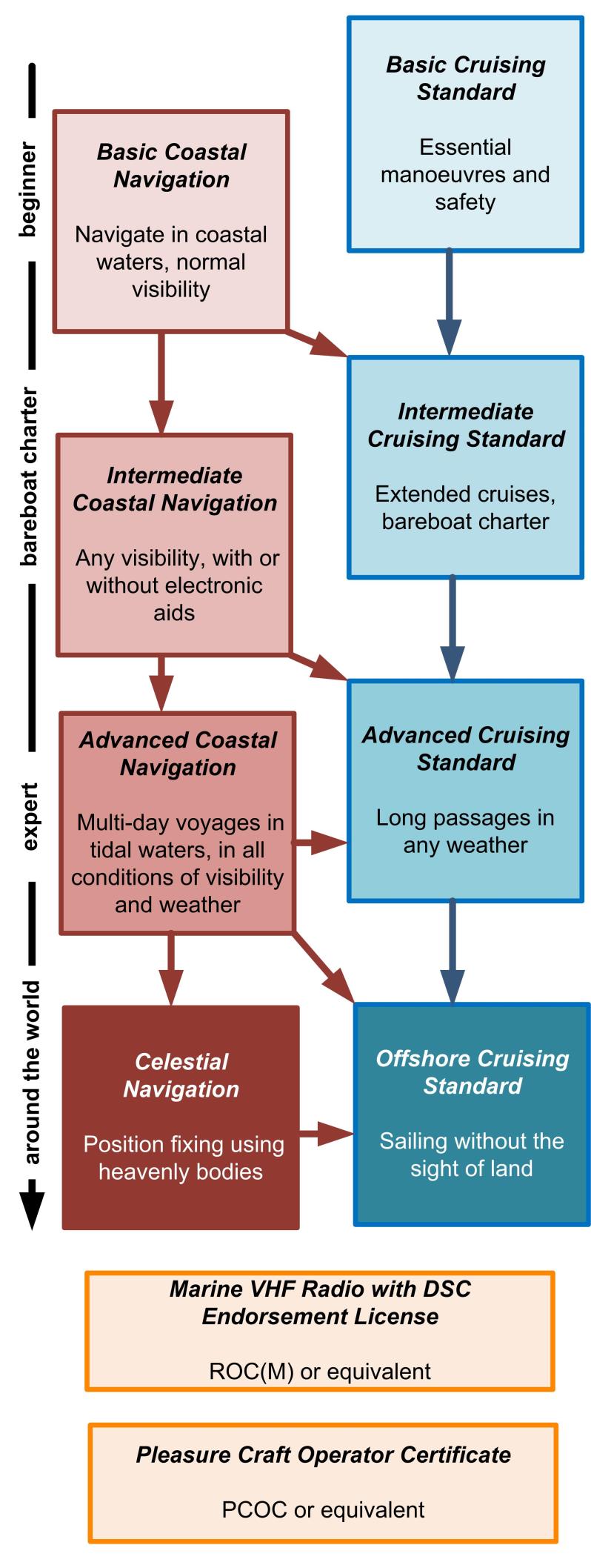
flow chart
Sailing licenses

Licensing for pleasure boating is not well regulated internationally. Different countries have different operator licensing schemes, and some do not require any, at least for non-commercial navigation. Many governments developed comprehensive licencing schemes for pleasure crafts, but only for motor powered. Others however have a "sailing" category. Vessel categorization also differs. So, it is not a surprise that there is no "international sailing licence" in existence. The most promising initiative is ICC (International Certificate of Competence), created by United Nations under resolution 40, but not all countries have signed it, USA and Canada including (2019).
So, the industry adapted to the situation. When chartering, the contract is usually taken to the port authority for approval, where they normally ask for some kind of "government boating licence" as a legal document. But charter agencies, as well as the insurance companies understand that those licences seldom guarantee proper training in sailing. This is where national sailing associations and their education programs come in place. Sign up for a sailing course with a reputable organization and beside acquiring proper sailing skills, you will also gain required certificate. Look for one that is normally accepted by the charter companies. We have seen charter boats with their sails sealed. With just a boating licence, a charterer could only sail under power. Only upon showing a "sailing certificate" the agency would unseal the sails.
Our advice is to acquire both, a government boating licence and a sailing certificate. Licence for marine VHF radio may also be required. Send copy of those to the charter agency before payment and ask if they are enough for bareboat chartering.
With "Sail Canada" certificate obtained through our school, you are automatically eligible for "Please Craft Operator Card", official proof of competency to operate vessels up to 20m, issued by Transport Canada.
https://www.tc.gc.ca/eng/marinesafety/debs-obs-paperwork-paperwork_operator-360.htm
One licence that is really broadly recognized is British RYA "Yachtmaster". This is the official British government licence for vessels up to 200BT, issued by "Royal Yachting Association". To obtain, you must pass the exam, which usually takes few days of evaluation. Going through RYA program is not required (Daysail, Coastal skipper ...), you can simply challenge the exam. Contact us if you are interested in preparation for the exam.
The word "Yachtmaster" was coined by "Sail Canada", it was an award for special achievements in the sport of sailing, but was sold to RYA in the 1940"s.

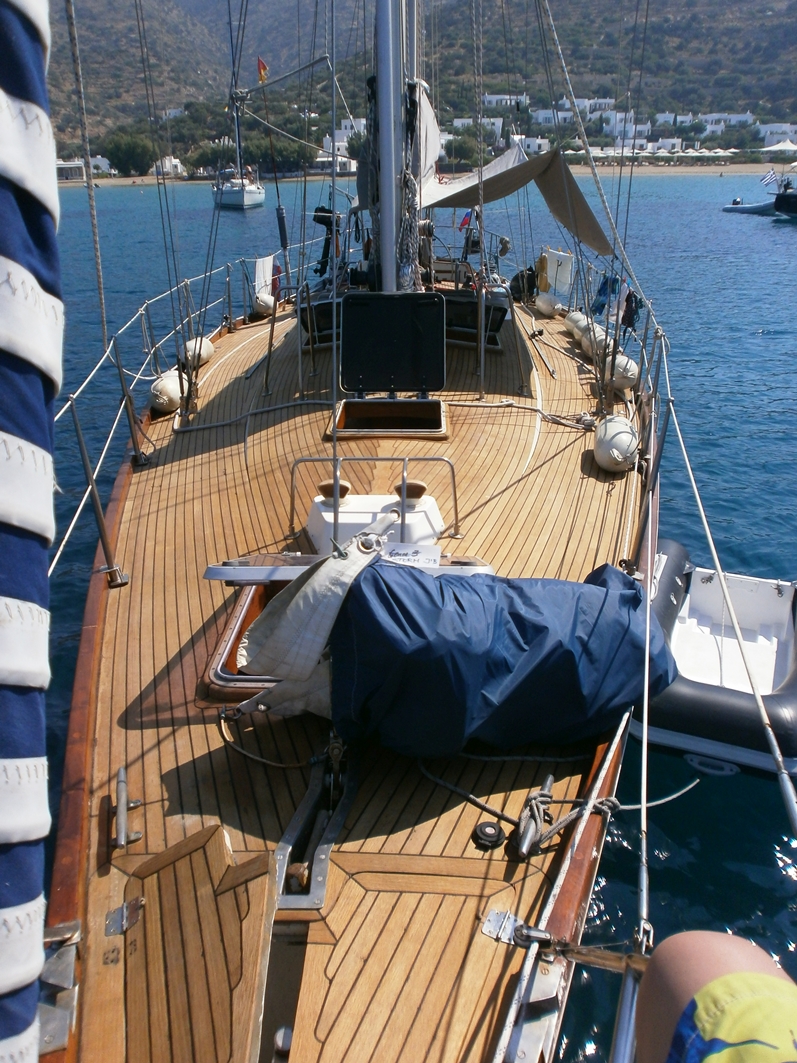
Maripossa deck
Participation Policy

For safety reasons and the enjoyment of all participants we require:
- PFD or life jacket must be worn whenever the instructor asks for it. We encourage you to wear it all the time;
- Safety harness must be worn when ordered by the instructor;
- Drugs and banned substances are not allowed on board, including marijuana;
- Sailing lessons up to wind and sea conditions of 'force 6' during the 'Intermediate' course, and up to 'force 5' during the 'Basic';
- We apologize, we cannot refund you the money for missed lessons because of the weather, although will try hard to re-schedule;
- Small alcohol consumption is acceptable after the lessons. If the instructor feels that someone has impaired judgment due to alcohol or any other reason, he/she will be required to stay ashore for the day;
- Smoking is allowed only on deck with due respect to safety and other participants;
- Harassment of any kind will not be tolerated.

Inappropriate or unsafe behavior against above rules, will result in termination of student's participation in the program without refund.

Cancelation policy:
- 90 or more days before the course start date - 100% refund;
- 90 to 30 days - 50% refund;
- less than 30 days - 20% refund.

We reserve the right to cancel courses if the number of signed-up students is less than 3 thirty days before the course, or under the unforeseable circumstances such as illness, major boat breakage, etc. In such cases the money paid will be fully refunded, however we cannot cover your travel expenses.


The above rules do not aply to flotilla participants. Every skipper participating in the flotilla is solely responsible for his/her crew and the boat. Members of Vega Sailing are only not-for-profit coordinators of the flotila activities, not related to teaching in any way.

Thank you.

Sunset